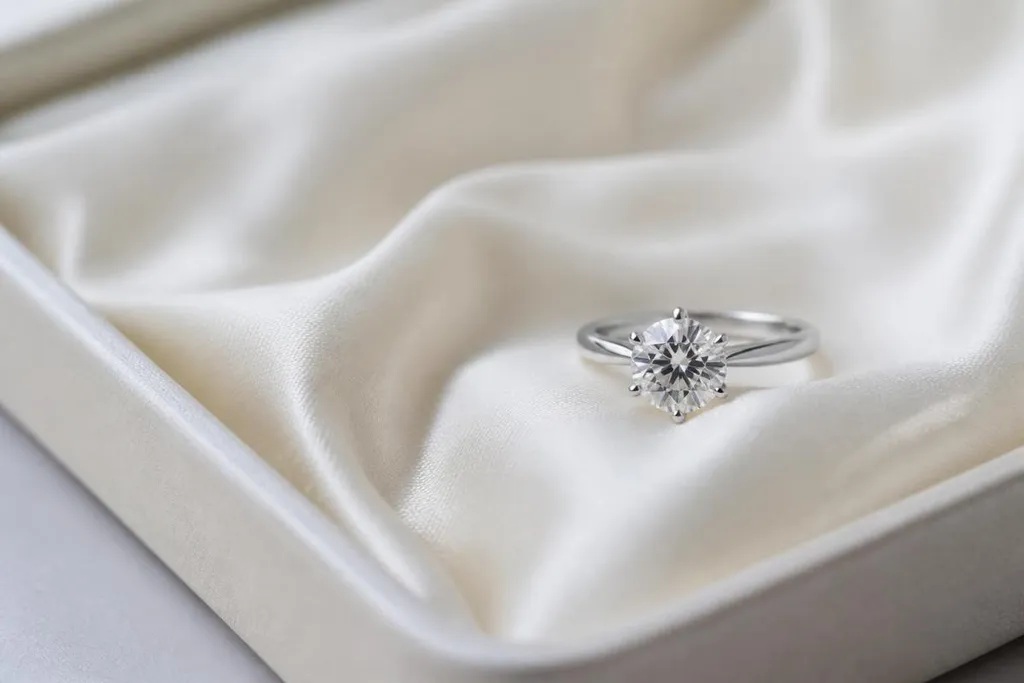
The round brilliant diamond has remained a defining engagement ring shape for good reason. Its appeal is not simply tradition. The cut is engineered around light performance, with a carefully arranged pattern of facets designed to return light through the top of the stone. That combination of symmetry and brilliance gives a round lab-grown diamond an unmistakable presence, even in a restrained setting.
Looking through beautiful lab diamond round cut rings also demonstrates how versatile the shape can be. A round centre stone can appear quietly classic in a solitaire, more decorative with diamond-set shoulders, or noticeably more substantial within a halo. Choosing well therefore means considering not only carat weight, but also cut quality, proportions and the setting surrounding the diamond.
Why Round Brilliant Diamonds Sparkle So Distinctively
A modern round brilliant diamond typically uses 57 or 58 facets, depending on whether the culet is counted. Their angles and arrangement are designed to manage how light enters, reflects within and leaves the stone.
This is why cut quality matters so much. A diamond can have excellent colour and clarity characteristics yet appear less lively if its proportions do not handle light effectively. Conversely, a beautifully cut stone can appear exceptionally bright because its facets work together efficiently.
Round diamonds are also valued for their balanced pattern of brilliance, fire and scintillation. Brilliance refers broadly to white light returned to the eye, while fire describes flashes of spectral colour. Scintillation is the pattern of light and dark, including the flashes seen as the diamond, wearer or light source moves.
Together, these characteristics explain why a round-cut lab diamond can remain visually engaging across changing lighting conditions.
Carat Weight Is Only Part of Perceived Size
Carat measures weight rather than diameter. Two round lab-grown diamonds with the same carat weight can therefore differ slightly in visible size depending on how their proportions distribute that weight.
A diamond carrying excessive depth may hide more of its weight below the surface, giving it a smaller face-up appearance than expected. This is one reason diameter and overall proportions deserve attention alongside the carat figure. Personal preference matters just as much. Someone might select a 2-carat round diamond because its width creates the degree of presence they want on a larger hand or alongside a substantial band. Another wearer may actively prefer a 1-carat or 1.5-carat stone because its proportions feel more refined, comfortable and consistent with understated jewellery.
The most successful choice is rarely the largest stone available within a budget. It is the one whose scale feels intentional once it is actually set on the ring.
How the Setting Changes a Round Diamond
The symmetry of a round diamond makes it particularly adaptable to different engagement ring settings. A solitaire keeps the outline clear and allows the diamond's brilliance to dominate. Four-claw settings can expose more of the stone, while six claws create a slightly more traditional appearance and can visually reinforce its circular shape.
Diamond-set shoulders extend sparkle along the finger without changing the centre stone's outline. A halo creates a different effect by surrounding the round diamond with smaller stones, increasing the ring's overall face-up footprint.
Band width also influences perceived proportion. A slender band can make the centre diamond appear larger by contrast, whereas a broader band creates a more substantial overall composition. Neither should be chosen solely to manipulate apparent size; the band must also provide visual and structural balance.
Consider the Complete Ring, Not Just the Diamond
Round lab diamonds are familiar enough that small design decisions become especially noticeable. Setting height, metal choice and wedding-band compatibility can all distinguish one ring from another.
Platinum and white gold create a cool backdrop that blends naturally with a colourless diamond. Yellow and rose gold introduce contrast and warmth, allowing the centre stone to stand out against the band.
Setting a profile should reflect everyday habits too. A high-set round diamond can have an elegant side view and may accommodate certain wedding bands more easily, while a lower setting can feel more streamlined for someone who frequently works with their hands.
Final Thought
The round-cut lab diamond has enduring appeal because its apparent simplicity is supported by sophisticated geometry. Cut quality determines how effectively it handles light, while carat, diameter and setting proportions determine how it looks on the hand.
Rather than choosing by carat weight alone, consider the diamond as part of a complete composition. A well-cut round stone in a thoughtfully proportioned setting does not need excessive complexity to command attention; its brilliance provides the character.